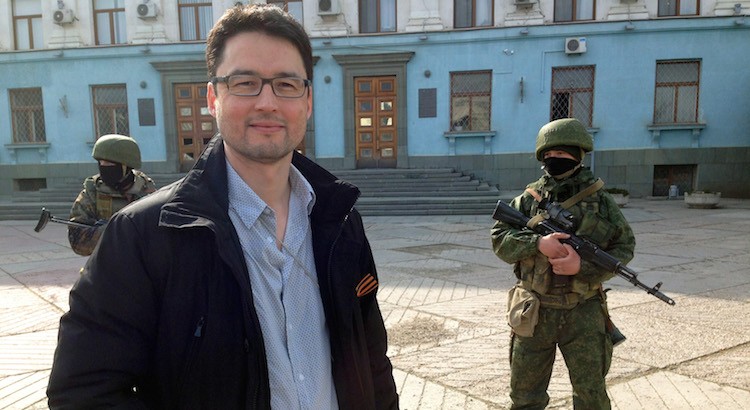
I flew into Kiev on February 20, the bloodiest day of the anti-government protests on Maidan Nezalezhnosti, Independence Square. That morning, dozens of demonstrators had been picked off by snipers as they advanced toward police lines on Instytutska Street in the heart of the city. Protected by metal shields and plastic construction helmets, the protesters were easy prey.
When I landed at Borispol Airport, the bloodbath was already over. I knew Kiev well from my days as a Moscow correspondent. Muscovites used to flock to the Ukrainian capital on long weekends to enjoy its European flair and joie de vivre. Now, as I took a cab into the city center, Kiev was dark and empty, reeling from a second day of violence. Government-hired thugs known as titushki were said to be roaming the streets.
For the previous three months I had ignored the Kiev protests against the kleptocractic rule of President Viktor Yanukovych. I considered the Maidan a domestic, Ukrainian struggle – and after a decade of covering Russia, I was eager to focus on new projects. Yet when the Ukrainian police began a violent crackdown on February 18 to clear the protest camp, I understood that the conflict was entering a new phase. Yanukovych’s Kremlin patron, Vladimir Putin, wouldn’t be sitting idly by, as he viewed Ukraine as his last line of defense from the contaminating influence of Western democracy.
Without a concrete assignment, I followed my journalistic instinct to Kiev. Events in the following days occurred at a dizzying pace. The day after my arrival – as part of a political deal brokered by Germany, France, and Poland – Yanukovych agreed to hold early presidential elections and restore the 2004 constitution curbing his executive power. The next day, he fled the capital, literally handing over the keys to government buildings and his luxurious residence to protesters. Ukraine was in free fall. Late that night I received a one-line email from an editor in New York: “Want to go to Crimea for us? Like, ASAP?”
Sunday, February 23
Activists from the Maidan were manning a checkpoint outside Kiev’s Zhulyany Airport. As Yanukovych abandoned the capital, law enforcement officers also vanished from the streets. The Maidan self-defense force, formed to protect protesters against riot police and provocateurs, was now patrolling the city in groups. They wore motley outfits consisting of old Soviet Army helmets, camouflage hunting jackets and plastic rain ponchos. They were armed with billy clubs and wooden stakes.
On the night of the Maidan massacre, there had been reports that members of Yanukovych’s clique were flying out of Zhulyany on charter jets. When the guard saw my American passport, he waved my cab through. I bought a ticket in the empty terminal building and boarded a tiny Saab 30-seater. In two hours, I was in Simferopol, the Crimean capital.
The Simferopol airport was so primitive that there wasn’t even a luggage belt – checked bags were simply deposited on the floor. A crowd of local men met travelers with the words: “Taxi? Taxi?” I asked my driver what he thought about Yanukovych – after all, Crimea, like the rest of Russian-speaking southeastern Ukraine, had solidly backed him in the 2010 presidential elections.
“I’m 1,000 percent against Yanukovych,” he said. And what about Russia? “90 percent of the people are for Russia,” he replied. Yanukovych’s corruption and pathetic escape from Kiev had wiped out any remaining popular support. Yet rather than see the Maidan protest as a citizen revolt, many people in Crimea were viewing it as a Western-engineered coup to pull Ukraine out of Russia’s orbit.
Crimea is an anomaly in Ukraine’s body politic. A peninsula the size of Sicily, it dangles from the mainland into the Black Sea and didn’t become a part of the Ukrainian Soviet republic until 1954. After Ukraine’s independence in 1991, Crimea was the only region granted the status of “autonomous republic,” a formal acknowledgment of its looser ties to Kiev. For the Kremlin, the Crimean peninsula continued to be of vital strategic interest as home to the Russian Black Sea Fleet based in Sevastopol.
The fall of Yanukovych presented Putin with a unique opportunity to reclaim Crimea. But when I checked into Simferopol’s deserted Hotel Ukraina, nobody imagined that a Russian invasion was being seriously considered – and would be completed in less than a week.
Monday, February 24
Two opposing sides best illustrated the struggle for Crimea’s future: the pro-Moscow Russian Unity party and the Crimean Tatar ethnic group, which was fiercely loyal to Kiev. The Muslim Crimean Tatars, whom Stalin deported to Central Asia during World War II, weren’t allowed back to their homeland until the dying days of the Soviet Union. Their return coincided with the birth of independent Ukraine.
Thousands of Crimean Tatars had gathered on Lenin Square the previous day to commemorate the 96th anniversary of the killing of their national hero Noman Celebicihan. Some of the demonstrators had wanted to pull down the Lenin statue – following the example of protesters in Kiev – but were stopped by their leader, Refat Chubarov, who gave the city 10 days to remove the monument “in a civilized way.”
I found Chubarov in the Mejlis, the Crimean Tatar assembly. A soft-spoken, bearded intellectual, he was born in exile in Uzbekistan, though his family was among the first allowed to return to Crimea following nonviolent demonstrations. In their peaceful struggle for justice, the Crimean Tatars allied themselves with the Soviet dissident movement. Chubarov’s mild-mannered but principled stance reflected that history.
Chubarov was calling for legislation that would give his community fairer representation in the regional parliament, followed by early elections. “I think that in the next week, there will be a new executive power here,” he told me, hardly anticipating how prophetic his words would be. “There is no domestic reason for conflict,” he said. “But there is the danger of an escalation if there’s external interference from Russia.”
Chubarov’s local rival was Sergei Aksyonov, head of the Russian Unity party, which claimed to represent the interests of ethnic Russians. When I finally found him, Aksyonov was sitting in his spartan office hidden behind a garage door and up a couple of flights of stairs. Aksyonov wore his gray hair in a buzz cut and had the thick arms of a wrestler. I expected him to be a Russian nationalist but was surprised that he answered my questions calmly, without a trace of ideological bluster.
Aksyonov said that Russian speakers were only reacting to events in Kiev and would defend their land if attacked. “There’s no question of breaking off, no question of a split,” he said. “The Tatars fear a split from Ukraine. But we say: Don’t look for problems where they don’t exist.” As Aksyonov spoke, three identical Nokia phones were ringing non-stop on the table in front of him. He answered two at a time. Self-defense units were already in training, Aksyonov told me. “We must always count on ourselves. We’re not counting on either Russia or the West.”
Tuesday, February 25
According to a post on Facebook, a pro-Russian demonstration was taking place in front of the Crimean parliament building. I grabbed my notebook and rushed over to the 7-story Soviet-era block. A crowd of several hundred people was gathering; some of the participants wore camouflage jackets, many were displaying the orange-and-black St. George’s band, a sign of remembrance of the Red Army’s victory in World War II. I saw a few Crimean flags and one Russian flag. “Sevastopol! Crimea! Russia!” the protesters shouted. Two days earlier, pro-Russian demonstrators in Sevastopol had proclaimed their own “people’s mayor,” who pledged not to follow orders from the new interim government in Kiev.
Vladimir Konstantinov, the speaker of parliament and a Yanukovych loyalist, finally came out and tried to calm the crowd. “I don’t plan to go anywhere,” he said. “We will fight for the autonomy of our republic to the end. Fascism won’t come to Crimea.” Konstantinov was interrupted by chants of “Referendum! Referendum!” and “Russia! Russia!”
It turned out the protesters were as unclear about their demands as I was. “We know about American-style democracy. Just look at Libya or Yugoslavia,” one man in a ski jacket told me. Then he added: “We want democracy, not anarchy. We want stability, just like you have in America.” Another man, driver Konstantin Dzhioyev, said he was against the new authorities in Kiev. “I think Crimea should be returned to Russia,” he said. A third man, artist Yevgeny Tishchenko, said he didn’t even care if Crimea stayed in Ukraine or joined Russia, as long as conflict was avoided.
“Clowns,” said a local journalist whom I met for coffee after the protest. “For them it’s better to be in Ukraine and get money from Russia. They don’t want to break off.” While there had been a real danger of a split in the years right after Ukraine’s independence, he said there was no longer a very strong separatist sentiment – otherwise Aksyonov’s party wouldn’t hold three seats in the 100-member Crimean parliament, less than the Tatars.
Later in the afternoon, I found myself sitting next to Aksyonov in the mansion housing Rossotrudnichestvo, the Russian government outreach agency for “compatriots living abroad.” Leonid Slutsky, a member of the Russian parliament from Vladimir Zhirinovsky’s nationalist party, had come to hear the concerns of the local Russian community. Slutsky promised “corresponding, appropriate measures” if the need arose, while stressing that “we’re for the territorial integrity of Ukraine.”
The well-fed guest from Moscow in his expensive suit pretended to listen to the dowdy, mostly elderly people who had come to see him. One man complained about the lack of coverage of Crimea on Moscow television channels. Many asked for financial help. Slutsky was so vague, cautious, and noncommittal, that I left the meeting convinced that he was just bluffing about any greater Russian involvement.
Wednesday, February 26
The day started with tension, as both Crimean Tatars and pro-Russians had called for dueling rallies. A thin line of police was guarding the plaza in front of the parliament building. Tatars from around Crimea were descending on the capital – thickset men with the physiques of wrestlers, wearing wool caps and dark jackets. They carried the light blue banner of the Mejlis and the Ukrainian flag. “Allahu akbar!” they cried, as new groups of Tatars arrived. “Glory to Ukraine!”
The compact, well-organized Crimean Tatar community – more than 12 percent of the peninsula’s population – was capable of mobilizing thousands of its members at a moment’s notice. They were joined by other citizens who supported the unity of Ukraine, including local soccer fans. “My mom is Russian, my dad is Polish, and I’m here with the Tatars,” said Sergei Pilipyonok, a local artist. “Russia will keep up the pressure. Things won’t calm down here so fast. It’s a ripple effect from Kiev. Now it’s our turn.”
The crowd continued to grow. Their goal was to stop the Crimean parliament from holding a special session to discuss a referendum on independence. The demonstrators pushed closer and closer toward the entrance. On the far side of the building, I could see the counter-demonstration by their Russian flags. A stand-off ensued. I returned to the hotel to get out of the biting wind and put on warmer clothes. In the meantime, the first scuffles broke out.
I returned to the parliament as Chubarov was telling his people to go home. As the Tatars and their Ukrainian allies dispersed, pro-Russian demonstrators took their place. The remains of the day’s fighting lay scattered on the pavement: broken flagpoles, the rubber sole of a shoe, a hat. A young Tatar limped by missing a shoe.
The pro-Russians weren’t in any less of a fighting mood. “We can’t let fascists come to power!” said Sergei Nalegayev, a sea captain who had driven up from Sevastopol with a few friends. “People want to join Russia because it’s our motherland.” An old woman passed crying that a man had been killed by the Kiev loyalists. It later turned out that the cause of death was a heart attack.
The Tatars’ show of strength had succeeded in stopping an independence vote in parliament and convincing the authorities to start talks on forming a new regional government. Given Slutsky’s half-hearted statement of solidarity the day before and the significantly larger crowd of pro-Ukrainian supporters, I went to bed certain that the threat of a Russian intervention had passed.
Thursday, February 27
When I woke up and checked the latest news on my iPhone, I couldn’t believe my eyes: sometime after 4 a.m., a group of heavily armed men had entered parliament, sent away the security guards, and raised the Russian flag over the building. There was no violence or taking of hostages.
I immediately pulled on some clothes and ran outside. A police line was blocking the approach to parliament. I called Aksyonov’s spokeswoman. She told me he was in talks with the gunmen. When Crimea’s deputy prime minister, Rustam Temirgaliyev, announced that parliament would meet for an extraordinary session in the afternoon, it all started to make sense: the vote on a referendum that had failed the previous day would be pushed through under force of arms.
Chubarov hastily called a press conference in the Mejlis. He said he saw a link between the seizure of parliament and Russian Black Sea Fleet armored vehicles that had been spotted outside of Simferopol in the morning. Ostensibly they were returning to Sevastopol from guard duty at an inland base when they ran into technical problems. Around Crimea, checkpoints were appearing that did not display Ukrainian state symbols, Chubarov said. He called on his people to remain calm and avoid any “provocations.”
The haggard Tatar leader spoke darkly of “third-party participants” in the day’s surprising developments. As for a referendum on independence, he said, “it’s not a Crimean cudgel, it’s a foreign one.” The Tatars’ main demand, he said, was that none of Crimea’s three main ethnic groups – Russians, Ukrainians, Tatars – were left out of the political process.
Pro-Russian demonstrators gathered in front of parliament. The Tatar-led rally from the previous day might as well have taken place a century ago. The people who gathered under Russian flags said they were concerned about efforts by the new Kiev government to downgrade the status of the Russian language. Crimeans needed to be able to vote on their future as a part of Russia, of Ukraine or as an independent country, said one demonstrator, who introduced himself as Sasha, a computer programmer. “If we need war to join Russia, I’m happy to live in Ukraine,” he added.
It didn’t take long for the Crimean parliament to vote to hold a referendum on May 25, the same day as Ukrainian presidential elections, oust the Yanukovych-era regional government, and name Aksyonov the new prime minister. The parliamentary session took place behind closed doors, without any journalists, in a building occupied by armed men. Nobody could even say how many deputies had really shown up.
Friday, February 28
I wanted to learn how local Maidan activists – who always represented a minority in Crimea – were dealing with the escalating political crisis. My meeting with Andriy Shchekun and Serhiy Kovalsky felt almost conspiratorial as we spoke in hushed voices behind white gauze curtains on the second floor of Café Parmesan.
Shchekun, a Ukrainian language and literature teacher, explained that the entire political class in Crimea had its roots in the criminal gangs that ran amok during Ukraine’s chaotic transition to capitalism in the 1990s. “They want to expand autonomy and stay in power to protect themselves,” he said. Kovalsky, an entrepreneur, said that he and Shchekun constantly faced threats, harassment, and vandalism. Less than two weeks after our meeting, Shchekun and Kovalsky’s father would be kidnapped by pro-Russian forces.
My phone was ringing. Overnight, soldiers without any insignia had taken up positions at the airport and now seemed to be fanning out across the peninsula. I found a driver named Ruslan, and we hit the road in search of the Russian Army. We hadn’t even left the city limits when we encountered five military trucks with black Russian military plates on the road from Sevastopol. We followed them until it became clear that they were not entering Simferopol but heading eastward.
We set off for Sevastopol. Outside Bakhchysarai, the former capital of the Crimean Khanate, we passed five armored personnel carriers, two with the Russian tricolor painted on their ventilation pipes. Three more were parked on the side of the road, as well as a giant Ural truck. It wasn’t far to a checkpoint with barriers of piled up tires. No soldiers, but Russian flags. Nobody stopped us, and we pressed on to Belbek, site of a Ukrainian air base.
Twenty self-defense militiamen were blocking the airport access road with a makeshift gate made out of pipes. About 100 meters away, a Ural military truck stood in the middle of the road. A dozen well-armed soldiers observed us. Andrei Sitnikov, the senior militiaman, said he’d called out to the soldiers but that they hadn’t reacted. He couldn’t say so, but we both knew we were looking at the Russian Army. The invasion was underway.
Later that night, I drove around Simferopol to see how the city was coping. The potholed streets of the former Russian imperial outpost were empty. At the local base of the Berkut riot police, which had battled with protesters on the Maidan, supporters were holding a vigil behind sandbags and razor wire. I asked a young man, who identified himself only as Alexander, what he thought about the arrival of Russian troops. “They’re not invaders. They came to help and take things under control,” he said. “They’re our brothers.”
Across town, at the headquarters of the Crimean Tatar television station ATR, the mood was grim. A couple of hundred Tatar men had shown up to protect their broadcaster. “They’re occupying us,” said Ruslan Temirkayayev, as an unmarked military truck trundled by. “We don’t need weapons. We’ll use our fists to defend ourselves.”
Saturday, March 1
I walked over to the Council of Ministers building on Lenin Square in the hope of catching Aksyonov. I wanted to ask him about stories that in a previous life he had been a gangster with the nickname “Goblin.” Instead I met a scrum of journalists and a dozen soldiers who stood guard wearing black masks and cradling assault rifles. One of them only said he was “local.” A Russian flag fluttered from the building.
Citizens started gathering on the square. One woman held up a sign with a pro-Russian text, and babushkas thanked the soldiers. A shouting match erupted when a man openly expressed his support for the Kiev government. He finally walked away to whistling and clapping. The crowd began heckling a BBC camera crew.
The soldiers had increased their presence since the previous day and were now patrolling the pedestrian zone in the city center. The Russian Foreign Ministry issued a statement claiming that there were casualties after armed provocateurs from Kiev had tried to seize the Crimean Interior Ministry overnight. When I visited the site of the alleged attack, everybody I met – from cops leaving the building to pro-Russian militiamen camped out across the street – said that nothing of the sort had happened. The Crimean Interior Ministry, straying off message, even posted a statement on its website denying the incident.
“Putin is great. He’s our life-saver,” a middle-aged entrepreneur, who gave his name as Oleg, told me. He and his wife were sipping take-away coffees as they strolled through the city center. Oleg blamed President Viktor Yushchenko, swept into power in the 2004 Orange Revolution, for Ukraine’s misfortune. Yushchenko had split the country by naming western Ukrainian guerillas, who had fought against the Soviet Union during World War II, as national heroes, Oleg said.
The new authorities moved swiftly to establish their authority. In the evening, Temirgaliyev, who had remained in the government, held the first news conference in the “international press center” at the Krim state television station. He announced that the referendum, which would now be held in March, was not about splitting off from Ukraine but about achieving the widest possible autonomy. Ukrainian Army soldiers based in Crimea were being disarmed and coming to the side of the Crimeans. The armed men in Simferopol were local self-defense units, not Russians. All of these statements would later prove to be lies.
The strangest week of my career was coming to an end. After I had first arrived in Simferopol, I didn’t meet a single other foreign journalist in the sleepy Crimean capital. Now there were camera crews from the world’s broadcasters roaming the streets. The editor who had originally sent me to Crimea on a couple of days’ assignment ordered me back to Kiev. It wasn’t easy to leave, but I knew that the big story was over. The takeover of Crimea was already complete.


